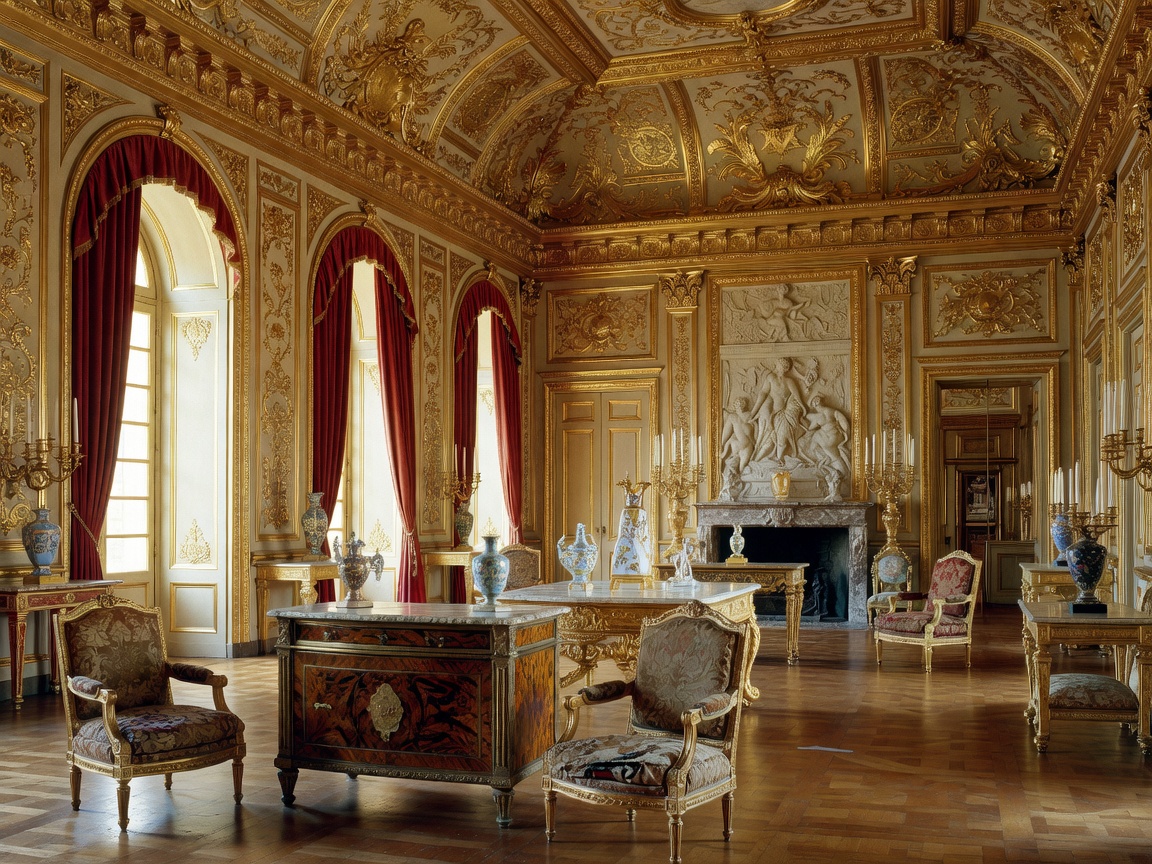
Celebrated by contemporary chroniclers as the "Eighth Wonder of the World," the Amber Room (Yantarnaya Komnata) represented the pinnacle of gemstone architecture in human history. Composed of over six metric tons of petrified Baltic tree resin, Florentine hardstone mosaics, intricately sculpted gilding, and mirrored panels, the 55-square-meter room cast an ethereal, warm golden glow that captivated tsars and visiting foreign dignitaries for over two centuries.
Yet in the catastrophic final months of the Second World War, this imperial masterpiece vanished into the smoke of collapsing East Prussia. Despite eight decades of intensive forensic hunts by Soviet counter-intelligence, the East German Stasi, Interpol, and private treasure hunters, the original chamber remains the most sought-after cultural fortune on earth.
From Prussian Royal Gift to Imperial Romanov Marvel
The room’s genesis began in 1701 in Charlottenburg Palace, Berlin, commissioned by Friedrich I, the first King of Prussia, and executed by German baroque sculptor Andreas Schlüter alongside Danish master craftsman Gottfried Wolfram. In 1716, seeking a geopolitical and military alliance against Sweden, Friedrich’s successor, King Friedrich Wilhelm I, presented the uninstalled amber panels as a diplomatic state gift to Tsar Peter the Great.
Tsar Peter had the panels transported to Saint Petersburg, but it was his daughter, Empress Elizabeth, who transformed them into a monumental architectural marvel. In 1755, she ordered Italian court architect Francesco Bartolomeo Rastrelli to install the room within the newly constructed Catherine Palace at Tsarskoye Selo (Pushkin). Because the Russian hall was far larger than the original Berlin quarters, Rastrelli ingeniously filled the negative spaces with additional Baltic amber, 24-carat gold leaf, mirrors, and four exquisite Florentine mosaics depicting the five senses made from jasper and onyx.
"When the candles were illuminated along the mirrored sconces, the walls appeared to burn with living flame. It was not merely a room of stone; it was an enclosed sky of golden light."
— Marquis de Custine, Empire of the Czar (1839)
- Weight of Fossilized Amber: Over 6,000 kilograms (13,000 lbs)
- Installation Dimensions: 55 square meters (590 sq ft) surface area
- Estimated Modern Reconstruction Value: $450,000,000 – $520,000,000
- Dismantled Date: October 1941 by German Wehrmacht Army Group North
- Crates Shipped to Prussia: 27 specialized wooden military crates
The Wehrmacht’s 36-Hour Theft
In September 1941, as the German Wehrmacht tightened its encirclement around Leningrad, Soviet museum curators desperately attempted to evacuate Tsarskoye Selo's treasures. However, the amber panels had become brittle with age; attempting to unfasten them caused the precious resin to crumble like dry parchment. In desperation, curators pasted paper wallpaper over the panels to disguise them.
The deception failed immediately. Soldiers of Army Group North discovered the room within hours of occupying Pushkin. Under the direct supervision of Count Ernstotto zu Solms-Laubach and museum director Georg Poensgen, acting on orders from the Kunstschutz (Art Protection squad), the room was systematically dismantled in thirty-six hours. Packed into 27 crates, it was shipped by rail to Königsberg Castle, the historic coronation seat of Prussian royalty on the Baltic coast.
The Final Days of Königsberg: Fire, Smoke, and Rubble
At Königsberg Castle, museum director Alfred Rohde exhibited several assembled panels in the castle’s southern wing until late 1943. However, with the Eastern Front collapsing, Rohde was instructed to pack the room into crates for evacuation into deep salt mines or southwestern Germany.
In August 1944, British Royal Air Force bombers launched devastating incendiary raids on Königsberg, destroying the upper levels of the castle. Rohde maintained that the crates had been safely moved to deep subterranean cellars beneath the knight’s hall. When the Red Army stormed Königsberg in April 1945 following savage urban warfare, the castle cellars were engulfed in rubble and flooded. Soviet search teams under Major Anatoly Kuchumov interrogated Rohde, but the museum director offered contradictory accounts before dying of typhus under mysterious circumstances in December 1945.
Forensic Recoveries and the Modern Replica
Dozens of conflicting theories have emerged regarding the room’s fate:
- The Wilhelm Gustloff Hypothesis: Packed aboard the naval transport vessel MV Wilhelm Gustloff, which was torpedoed and sunk by a Soviet submarine in January 1945, carrying thousands of refugees and military cargo into the Baltic seabed.
- Thuringian & Polish Mine Shafts: Secretly entombed inside the complex salt mine networks of Walbrzych or Merkers by the retreating SS.
- Incineration at the Castle: Completely incinerated during the April 1945 artillery bombardment, leaving only ash and melted slag that was subsequently bulldozed by Soviet demolition squads in 1968.
In 1997, a stunning breakthrough occurred: German police seized an authentic mosaic panel from the Amber Room (the Florentine panel Touch and Smell) in Bremen, where a former German soldier’s son had attempted to sell it on the black market. This proved conclusively that at least portions of the room had survived the war and were looted by individual soldiers rather than destroyed en masse.
In 1979, the Soviet government embarked on an ambitious cultural project: reconstructing the Amber Room panel by panel using authentic archival blueprints, German black-and-white photographs, and Baltic amber. Completed after twenty-four years of painstaking craftsmanship funded in part by German energy firm Ruhrgas, the reconstructed Amber Room was inaugurated in 2003 at the Catherine Palace by Russian President Vladimir Putin and German Chancellor Gerhard Schröder. Yet the original $500 million Romanov wonder remains one of history’s greatest unrecovered ghost fortunes.